









From 1 January 2027, Italian VAT moves to a new address. Rates and deduction rules stay the same: what changes is the numbering of the articles that contain them.
The new Consolidated VAT Act (Testo Unico IVA) brings together in a single measure a body of rules that has gone through more than 500 amendments since 1973, as Deputy Minister of Economy and Finance Maurizio Leo pointed out.
For anyone who reads the legislation, it is a matter of getting used to new numbers. For companies running business software or an ERP, it means updating the system: every VAT code, invoice wording or posting code that cites "art. 8 DPR 633/72" today points to a provision that will be repealed from 2027 and needs updating. Below we look at what really changes, where the impact hides in business systems and how to organise the work in the weeks that remain.
What the Consolidated VAT Act is and when it applies
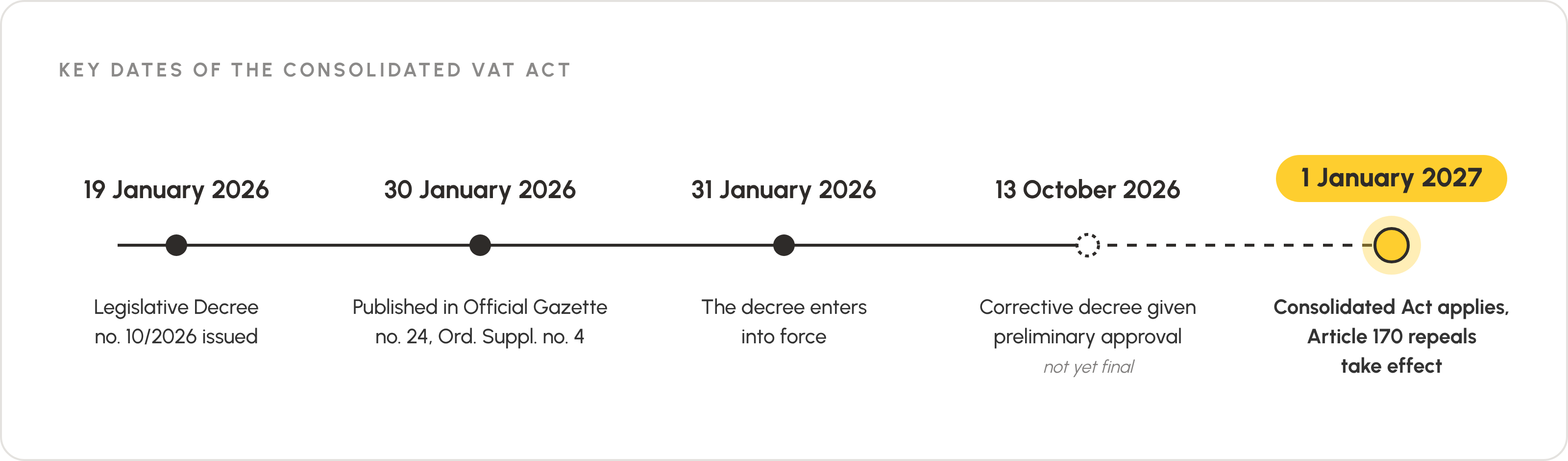
The Consolidated VAT Act is Legislative Decree no. 10 of 19 January 2026, which implements the tax reform enabling law (Law 111/2023). It sets out the rules of the tax in 171 articles, grouped into 18 titles, and four annexed tables.
The decree has formally been in force since 31 January 2026, but its provisions apply from 1 January 2027, together with the repeals listed in Article 170.
The one-year postponement, set by the Milleproroghe decree, brought the date into line with the other consolidated acts of the reform.
The Consolidated Act brings together Italy's original VAT law, DPR 633/1972, and the related rules on intra-EU trade (DL 331/1993), the margin scheme (DL 41/1995) and electronic invoicing (Legislative Decree 127/2015). Invoicing, record-keeping, periodic VAT settlement and refunds stay in, while assessments and penalties move to other consolidated acts. The articles follow the order of EU Directive 2006/112/EC, which is why almost every number changes.
Scope: what changes
The substance stays the same. The standard rate is still 22%, with reduced rates of 10%, 5% and 4%. The conditions of taxability, exemptions, deduction rules and compliance obligations are not rewritten. The Relazione illustrativa, the explanatory report that accompanies the decree, describes the text as a compilation. The rules move into the Consolidated Act with the same wording, apart from updating references that are out of date.
What does change is the set of tables. Tables A, B and C of DPR 633/1972 and the margin scheme table become four annexed tables:
Table A for agricultural and fishery products and for goods and services at 4%, 5% and 10%
Table B for products subject to specific rules
Table C for shows and recreational activities
Table D for works of art, antiques and collectors' items under the margin scheme.
The changes in substance are few and cover specific cases. For exports, Article 45 now refers to "customs exit proof". The 10% rate on building renovation work now refers directly to the Consolidated Building Act (DPR 380/2001). For imports, the text incorporates the rule introduced in 2024: goods are not confiscated if the person liable pays the tax, interest and penalty.
VAT rates (22, 10, 5 and 4%)
.Conditions of taxability
Exemptions
Input VAT deduction
Compliance obligations
Article numbering
New Tables A-D
Customs exit proof for exports
Reference to DPR 380/2001 for the 10% building rate
Confiscation on imports
The picture is not settled yet, though. On 13 October 2026 the Council of Ministers gave preliminary approval to a corrective decree for the consolidated tax acts. For VAT, it proposes, among other things, repealing Article 89 on administrative and accounting simplifications and paragraph 8 of Article 82 on the electronic transmission of daily takings. The corrective decree is not final yet: anyone updating their systems should follow it through to publication.
VAT codes, invoices and XML flows
The most exposed area is the VAT code master data. In almost every business system, the codes for zero-rated, exempt, reverse charge or split payment transactions carry a description with the legal reference. That description ends up printed on the invoice and in the RiferimentoNormativo field of the XML file: from 2027 it will point to a repealed provision.
The e-invoicing Natura codes (N1, N2.1, N3.1 and so on) are a separate matter. They are defined by the Italian Revenue Agency's technical specifications and do not change because of the renumbering: they could only change with a new version of the specifications. Internal VAT codes and their descriptions, on the other hand, need to be updated by whoever manages the system.
There is a safety net, but it has limits. Article 170 states that when laws, decrees or other measures refer to repealed provisions, the reference applies to the corresponding provisions of the Consolidated Act. The clause, however, covers legislation, not invoices. An outdated reference on a 2027 document would most likely be a formal inaccuracy. Even so, the clause does not guarantee consistency across master data, print layouts and automated processes, and does not correct VAT treatment that is wrong in substance.
Besides VAT codes, legal references often appear in:
- fixed texts in print layouts
- posting codes
- wording linked to declarations of intent
- framework agreements and sales orders
- internal manuals
- reports that filter by legal reference
Then there is the purchasing side. In the first months of 2027, supplier invoices will arrive with old and new wording for the same transaction, and automatic posting rules will need to recognise both.
Old and new articles: the most common correspondences
These are the references that come up most often in business system configurations. Before changing a code, always check the article and paragraph against the official text or on TrovaTU, the Ministry of Economy and Finance tool that shows where a current provision has moved within the new consolidated acts.
Subject | Until 31/12/2026 | From 1/1/2027 |
|---|---|---|
Supplies of goods | Art. 2 DPR 633/72 | Art. 5 |
Supplies of services | Art. 3 DPR 633/72 | Art. 10 |
Time of supply | Art. 6 DPR 633/72 | Art. 24 |
Place of supply of services | Art. 7-ter DPR 633/72 | Art. 17 |
Exports and zero-rated supplies | Art. 8 DPR 633/72 | Art. 45 |
Exempt transactions | Art. 10 DPR 633/72 | Art. 37 |
Taxable amount | Art. 13 DPR 633/72 | Art. 27 |
VAT rates | Art. 16 DPR 633/72 | Art. 34 |
Reverse charge | Art. 17 DPR 633/72 | Art. 64 |
Split payment | Art. 17-ter DPR 633/72 | Art. 65 |
Input VAT deduction | Art. 19 DPR 633/72 | Art. 56 |
Invoicing | Art. 21 DPR 633/72 | Art. 72 |
Simplified invoice | Art. 21-bis DPR 633/72 | Art. 73 |
Credit and debit notes | Art. 26 DPR 633/72 | Art. 92 |
Intra-EU supplies | Art. 41 DL 331/93 | Art. 39 |
Margin scheme | Art. 36 DL 41/95 | Art. 143 and Table D |
The text itself helps: every article of the Consolidated Act states in its heading the provision it derives from, which makes the mapping easier to document.
What to check in your business system
Before changing a code, it is worth knowing where the references are.
In an ERP the same reference can appear in several places, including some you might not expect, such as lookup tables or the logic that generates the XML file. This applies to any setup: standard functionality, an intermediary or custom development. For each point, what matters is who reads the reference and when.
Timing matters more than it seems. If the system reads the wording from master data only at print time, changing it on the night of 31 December has a side effect: a 2026 invoice reprinted in February will show the new reference. Where possible, store the text on the document when it is issued, or manage wording with a validity date.
Watch out for customisations too. Software vendor updates normally cover the standard configuration. VAT codes created or modified in-house, custom texts and the rules that assign VAT to each customer or transaction type need to be checked one by one.
A work plan for the weeks that remain
There are only a few weeks left before 1 January, and December is the month of year-end closing. It makes sense to start now, organising the work in four phases.
Inventory
Extract from the system every VAT code, text and posting code that cites a legal article, along with the print layouts and rules that use them.
Mapping
For each reference, identify the new article and have it validated by whoever handles tax matters. Those who manage the system implement the change; they do not decide the tax treatment.
Testing
In a test environment, apply the changes, issue a sample of invoices for each transaction type and check printouts, XML and postings, including transactions that span the year end. This phase should be completed by mid-December.
Go-live and monitoring
The changes move to production on a set date and, in the first quarter of 2027, the first postings and incoming invoices are checked.
Contact Us
In the ERP projects we work on, we are doing this alongside our clients' finance teams. If you want to know how much work your system needs, contact us for a review of your references before December.
Contact us to find out more →